
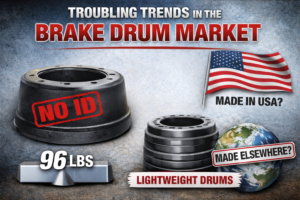
At DuraBrake, we spend a great deal of time listening to fleets, distributors, dealers, and service professionals across the country. That ongoing dialogue often gives us early visibility into trends that deserve broader attention. Recently, several developments in the brake drum market have raised serious concerns—concerns that directly impact safety, accountability, and trust throughout the heavy-duty market.
Below are three issues we believe the industry must address sooner rather than later.
1. Brake Drums With No Permanent Brand Identification
One of the most troubling trends we continue to see is the sale of brake drums with no permanent brand identification cast or stamped into the product. This is not a cosmetic feature—it is fundamental to product accountability. Without permanent identification:
- There is no reliable way to trace the drum back to its source
- Warranty responsibility becomes unclear or impossible to enforce
- Quality issues cannot be effectively investigated or corrected
- Fleets and installers are left exposed if a failure occurs
We have already addressed this issue in a previous Braking News article, yet the problem persists. The continued circulation of unidentified drums suggests that some products are entering the market with little regard for long-term responsibility or safety.
If a brake drum cannot clearly identify who made it and where it came from, that alone should raise serious red flags.
What this means for distributors and dealers: If a dealer or distributor sources non-branded drums from multiple suppliers, which supplier bears responsibility if a drum fails years later—after packaging labels have burned off?
Likewise, fleets typically do not track which supplier each individual drum was purchased from. If a fleet purchases non-branded drums from multiple dealers, how can the failed drum be traced back to the seller? Selling or distributing non-branded brake drums may unintentionally expose your company to unnecessary and unwarranted risk. Ensuring that every drum carries a reputable, permanent brand identification is a critical step in protecting both your customers and your business.
2. Hidden Weight Pockets and Crack Origination Concerns
Another increasingly reported issue involves weight pockets on the inside of brake drums—features that are not visible unless the drum is flipped over.
These weight pockets are used to remove weight, and thus cost. Because the pockets are located on the inside of the drum, some distributors and dealers may not even realize the drums they are purchasing contain them. Many customers have reported that these weight pockets appear to act as origination points for cracking. Because these pockets are hidden during normal inspection, cracks can form and propagate before they are detected.
This raises several concerns:
- Stress concentration in non-uniform drum structures
- Reduced fatigue life under repeated thermal and mechanical loading
- Difficulty identifying early-stage failures during routine inspections
Brake drums operate under extreme heat and load cycles. Any design feature that introduces localized stress without adequate material support or quality control deserves careful scrutiny. When customers repeatedly report similar crack patterns, it is a signal the industry should not ignore. We strongly encourage distributors and dealers to physically inspect the inside of the drums they are sourcing and selling, so they understand whether weight pockets are present and what risks they may introduce.
3. Misunderstanding—and Possible Misrepresentation—of “Made in the USA”
Perhaps the most sensitive issue we are seeing involves country-of-origin assumptions.
Many dealers and distributors believe they are purchasing brake drums from programs they assume—or even promote—as being made in the USA. In some cases, marketing materials, stickers, or branding that include references to “USA” or the use of a U.S. flag can create the impression of domestic manufacturing, even when the drums themselves are produced overseas. These assumptions can lead to drums being sold downstream at a premium based on domestic-origin claims. In reality, some of these drums are not made in the USA, and in many cases, no one at the dealer or distributor level realizes it.
This creates several serious risks:
- Unintentional misrepresentation to fleets and end users
- Potential compliance issues with labeling and procurement requirements
- Erosion of trust when the true origin is discovered—often cast directly into the drum itself
Assumptions are not enough—verification matters. A U.S. flag on a sticker or a company name that includes “USA” does not necessarily mean the product itself was manufactured domestically. Distributors and dealers should verify country of origin directly on the drum and through documented supplier confirmation before making or passing along any domestic-origin claims.
4. Ultra-Lightweight Brake Drums and Heat Capacity Concerns
Another concerning trend we are seeing is the emergence of 16.5 x 7 cast brake drums with weights as low as 96 lbs, with no additional strengthening (like a steel-shell drum for example), primarily driven by cost reduction.
Brake drums are not just structural components—they function as critical heat sinks. Adequate mass is essential for absorbing, dissipating, and managing the extreme heat generated during braking. Reducing material to lower cost directly reduces a drum’s thermal capacity and strength, which can increase the risk of:
- Higher operating temperatures
- Accelerated wear and cracking
- Reduced braking consistency under demanding conditions
- Shortened overall service life
- Catastrophic failure
At DuraBrake, our standard 16.5 x 7 cast drum weighs approximately 105 lbs, reflecting the material mass required to properly manage heat and deliver consistent, durable performance and strength. While lighter drums may offer short-term cost savings, they can introduce long-term risks that far outweigh any initial price advantage.
When evaluating brake drums, weight should be considered and verified—it is a performance and safety factor that deserves careful consideration.